
What you can and cannot bring into a European stadium
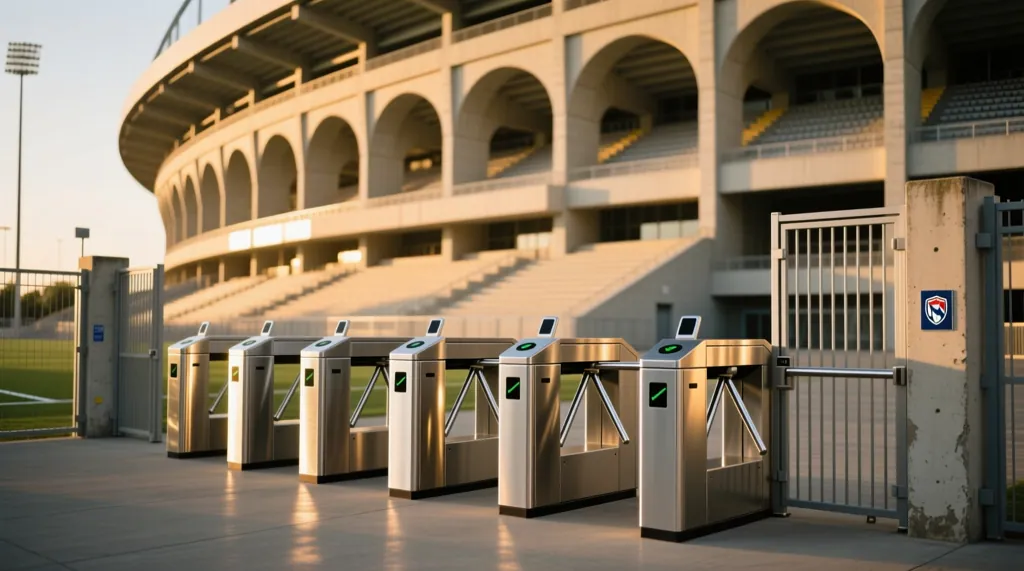
Every ground in this guide applies the same broad logic to what goes through the turnstiles, even though the detail changes from city to city. Understanding the logic rather than memorising each club's list is what keeps a matchday simple, because the rules are built to answer one question: can this object be searched, stored and made safe?
The bag rule, and why it causes the longest queues
The near-universal rule is a small-bag policy. A bag that fits under a seat is normally admitted after a search; a rucksack or anything larger is normally refused.
The reason is practical rather than hostile. A ground of sixty thousand people has no space to store thousands of bags, and a large bag hides items that a search cannot resolve quickly.
The consequence is the queue. Searches at the turnstile are the single biggest cause of late entry, so the smaller the bag, the shorter the wait.
No left luggage, almost anywhere
It is a common misconception that a stadium will hold a bag for you. Most grounds in this guide have no general baggage facility at all, and the few that do fill within minutes of opening.
That makes the bag decision a transport decision. If your route to the ground involves arriving from an airport or a station with luggage, the luggage needs a destination before the ground, not after it.
The matchday essentials
- Keep the bag small enough to fit under a seat.
- Sort out luggage before the ground — there is no storage there.
- Check whether your flag pole is collapsible and short.
- Agree any drum in writing with the club before travelling.
- Leave glass, cans and outside food behind.
- Arrive early with the bag open and ready to be searched.
Flags, banners and poles
Flags and banners are generally welcome at European grounds, and in some countries they are central to the matchday culture rather than tolerated alongside it. The common conditions are that the material is flame-retardant, the message is not offensive or political, and the flag does not block a gangway or a sightline.
Poles are the part that trips people up. Flexible, collapsible poles are usually allowed; rigid poles are usually not, and the definition of too long varies. A pole that cannot be folded into a small bag is a risk at every turnstile in this guide.
Large flags hung over a tier often need a fire certificate and prior agreement with the club, which is why organised supporter groups handle them rather than individuals.
Drums, instruments and organised noise
Drums are the most tightly controlled category. At club grounds they are effectively reserved for the organised groups that already have permission, and an unannounced drum will normally be refused.
In the away section the position varies. Some clubs allow a visiting drum with prior agreement between the two clubs; others do not allow one at all. The safe assumption is that a drum needs to be agreed in writing before the trip.
Megaphones and whistles fall into the same category. They are treated as instruments rather than as personal items.
| Item | Status | Notes |
|---|---|---|
| Small bag | Allowed | Searched at the turnstile; must fit under a seat. |
| Large rucksack or suitcase | Refused | No general left luggage at the ground. |
| Flexible flag pole | Restricted | Usually allowed when short and collapsible. |
| Rigid pole or stick | Refused | Policed at every ground in this guide. |
| Flame-retardant banner | Allowed | Must not block gangways or carry offensive messages. |
| Drum | Restricted | Needs written agreement, normally for organised groups only. |
| Glass or cans | Refused | Applies to water bottles as well as alcohol. |
| Outside food | Restricted | Usually refused except for medical or dietary needs. |
| Camera with a long lens or tripod | Restricted | Personal cameras allowed; professional kit needs accreditation. |
Food, drink, cameras and everything else
Outside food and drink are usually refused beyond a small exception for medical or dietary needs, and the exception is normally agreed in advance rather than argued at the gate.
Glass and cans are refused everywhere. That applies to a bottle of water as much as to a beer, so a sealed soft drink is a better choice than a reusable glass bottle.
Cameras are usually fine for personal use, while professional equipment with long lenses or a tripod needs accreditation. The dividing line is whether the equipment looks like broadcasting rather than spectating.
How to get through the turnstile quickly
Arrive early, carry little, and keep the bag open and ready. The supporters who queue longest are the ones who bring the most and arrive at the last minute.
Check the specific ground before you travel. The rules in this guide are the common pattern, but each club publishes its own list and adjusts it for bigger fixtures.
The rule that matters at every ground in this guide is the same one: the less you carry, the faster you are through the turnstile and the fewer problems you create for yourself. Everything else in the bag policy follows from that.